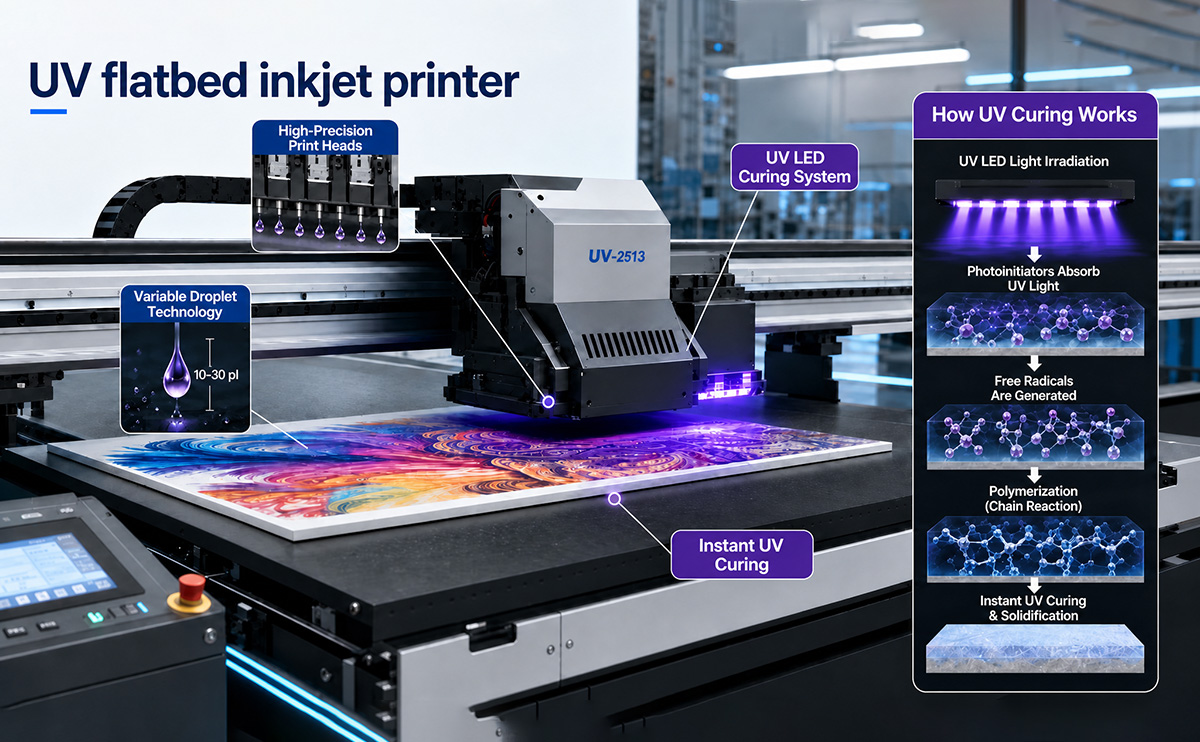
As an important member of modern digital printing equipment, the UV flatbed inkjet printer is widely used in fields such as advertising production, packaging proofing, home decoration, and personalized customization. The key factors influencing its printing quality mainly focus on two aspects: print head precision and curing principles. The following will provide a detailed analysis of these two core technologies and explain how they determine the quality and expressiveness of the finished products.
I. Print Head Precision: The Decisive Factor for Image Restoration
1. Print Head Resolution
The print head is the "core output organ" of the UV inkjet printer. Its resolution (usually expressed in dpi) directly affects the clarity of the pattern and the color restoration ability. High - resolution print heads can achieve smoother color gradation transitions and sharper edge effects, especially performing outstandingly when printing photo - like patterns, text, and gradients.
2. Ink Droplet Control Technology
Advanced print heads support the Variable Dot Technology, which can precisely control the size of ink droplets according to the needs of the image. Large ink droplets are used to fill color blocks, while small ink droplets are used to present details. This effectively enhances the printing 层次感 (level of layering), reduces graininess, and makes the image more natural and realistic.
3. Print Head Arrangement and Driving Method
The arrangement density of print heads and their driving systems also affect precision and speed. High - speed printing often involves the transverse scanning of print heads and precise control technologies. The accuracy of servo motors, encoders, and guide rails determines whether the printed image will have flaws such as ghosting, streaking, or misalignment.
II. UV Curing Principle: The Guarantee for Imaging Effect and Durability
1. Reaction Mechanism of UV Curing Ink
The ink used in UV flatbed printers is of the ultraviolet - curable type. That is, when irradiated by a UV LED light source, the photosensitive resin in the ink rapidly cross - links and cures. Compared with traditional solvent - based inks, UV inks can dry instantly after being ejected, are not prone to bleeding or spreading, and ensure the edge clarity of the image.
2. Matching of Curing Lamp Power and Wavelength
The power and wavelength of the UV lamp have a huge impact on the curing effect. Insufficient power can easily lead to incomplete curing, resulting in problems such as stickiness and ink shedding; mismatched wavelengths will reduce the curing efficiency. Professional equipment often uses multi - band LED lamps (such as a combination of 395nm + 365nm) to adapt to different brands of UV inks and improve compatibility and curing effects.
3. Cooling System and Energy Control
To prevent the material from being deformed by heat, modern UV printers are generally equipped with air - cooling or water - cooling systems and have an energy adjustment function. Reasonable cooling and energy control not only extend the lifespan of the LED lamp but also avoid deformation and charring on heat - sensitive materials such as plastics and films.