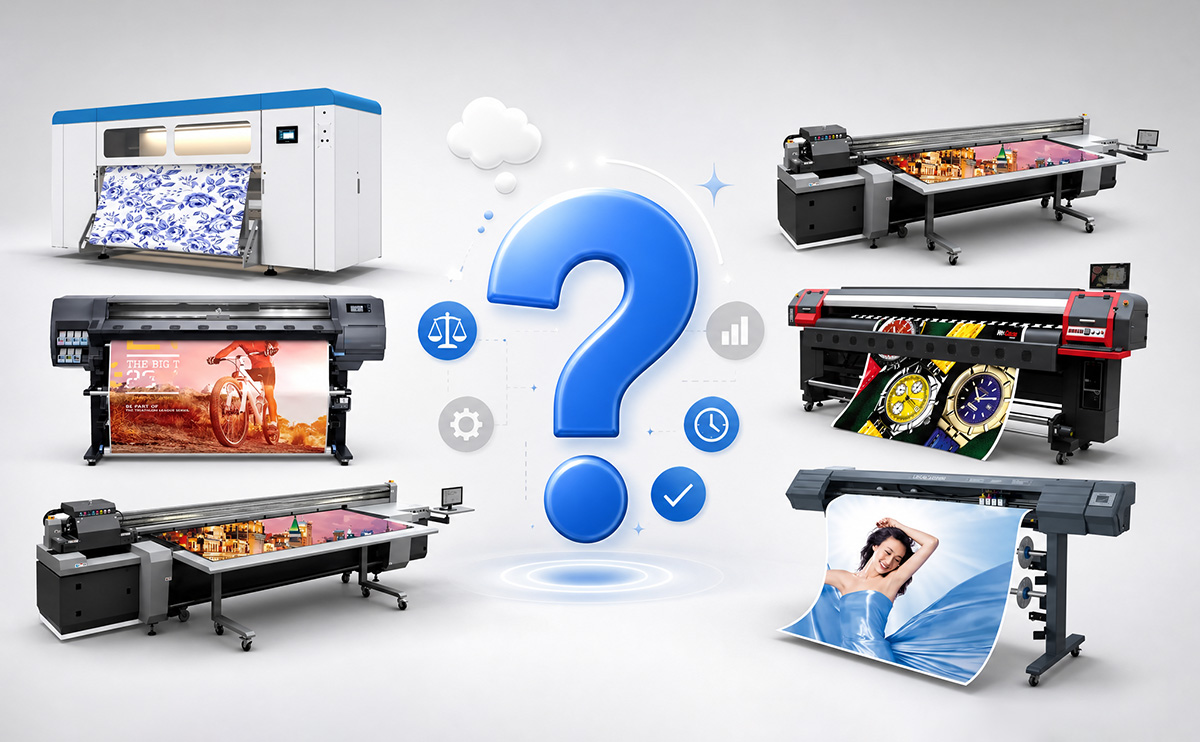
Understanding the Six Types of Inkjet Printers in Ads
Posted by
Admin
15
May
1. Outdoor Large - format Inkjet Printers (Solvent Ink)
- Definition: An early - stage wide - format printing device in the advertising industry and a milestone product in the inkjet printing field.
- Specifications: Usually 3.2 meters and 5 meters.
- Application Scenarios: Used for making outdoor billboards, construction site fences, event backdrops, etc.
- Current Situation: Coarse in fineness, low in material cost, and with gradually decreasing sales.
- Ink Characteristics: Solvent - based ink, mainly composed of organic solvents, mostly using esters and ketones. It corrodes and swells the medium during the combination process with the medium, closely bonding the colorants in the ink with the substrate. So, it doesn't require the medium to have a coating, and its fast - volatilizing property can meet the requirements of high - speed printing.
- Common Brands: Cyber, Gongzheng, Aowei, Liebao, Jixian, Caishen, Tuwang, Renous, Xuli, etc.
2. Indoor Photo Printers (Water - based Ink)
- Width: Mainly 1.6 - meter width.
- Features and Applications: Fine in precision, bright in color, suitable for close - up viewing. Using water - soluble dye ink, which is odorless and less polluting. Usually, the images made with water - based ink are mainly applied indoors due to poor weather resistance, such as POP in shopping malls and supermarkets, posters, displays, etc. If high precision, bright colors, and strong weather resistance are desired, the original ink (or pigment ink) of indoor photo printers is a good choice. Imported equipment is mainly used, such as HP, EPSON, Canon, etc., mainly for the imaging industry, high - end light box films, art reproduction, etc.
- Common Brands:
- Imported: EPSON, HP, Roland, Mutoh, Mimaki, Canon, etc.
- Made in China: Licai, Xuli, Renous, Aowei, Tiancai, etc.
3. Outdoor Photo Printers (Eco - solvent Inkjet)
- Definition: A new type of outdoor solvent inkjet printer improved based on the outdoor large - format solvent inkjet printer.
- Features: Reduces VOC toxic substances and odors. Its image precision can be comparable to that of indoor photo printers, with strong weather resistance, and can be applied to substrates without coatings (some substrates need eco - solvent ink - absorbing coatings). The width has developed from 1.6 meters to 3.2 meters. Thus, it has quickly replaced the large - area outdoor large - format printers and the original water - based printers with weather - resistance requirements, and is currently a device with a large market share.
- Application Scenarios: Advertising in shopping malls, outdoor stores, vehicle bodies, short - term signs, floor stickers, etc.
- Common Machine Brands: DGI, Epson, Roland, Mutoh, Mimaki, Cyber, Aowei, Gongzheng, Caishen, Renous, Xuli, Raitu, Saitu, etc.
4. UV Printers (UV Ink)
- Principle: Essentially a type of piezoelectric inkjet printing device. The ultraviolet waves emitted by the LED cold light source lamp react with the photosensitive curing agent in the UV ink, causing the pigment molecules in the UV ink to solidify on the surface of the material. It dries immediately after printing, so curing is the most significant feature. It has outstanding weather resistance, is not limited by materials, has rich and full colors, and better internal light effects.
- Classification and Applications:
- Roll - type UV Printers: Mainly print rolls for large - format advertising images, such as media advertising spaces in airports, subways, and stations. Since the images may need to be rolled or folded, flexible UV ink is required to avoid ink layer cracking caused by image distortion during transportation or installation.
- Flat - bed UV Printers: Used for printing on plates, such as PVC plates, acrylic plates, glass, aluminum plates, and other sign - making products. They can also print patterns with embossed effects and are often applied in the fields of decorative paintings, handicrafts, packaging, as well as ceramics, floors, etc. Hard UV ink is used mainly to prevent scratching.
- Roll - flat Integrated UV Printers: Make full use of the advantages of industries such as electronics, control, and chemistry, and have the dual - function of printing on rolls and plates. Usually, neutral ink is used.
- Common Brands:
- Imported: Durst, EFI, SwissQ, Dilli, etc.
- Made in China: Taiwei, Flyingboat, JHF, Caishen, Dongchuan, Hantuo, Jixian, Dingli, Jinyutian, Cyber, Aowei, Gongzheng, Renous, Xuli, Aijieli, Saitu, EPcolor, etc.
5. LATEX Printers (LATEX Latex Ink)
- Launch Information: Produced and released by HP in the United States in 2008, and many series have been launched one after another. Currently, its application in the inkjet industry is relatively niche.
- Principle: The LATEX ink is printed on the medium. The latex component in the ink melts when heated and then solidifies on the surface of the medium to fix the pigment component in the ink when cooled, achieving image printing and color fixation.
- Ink Characteristics and Applications: It is an environmentally friendly functional ink. Based on its pigment - ink colorant substrate and resin - latex additive formula, it has the advantages of the imaging durability of traditional solvent inks and the environmental friendliness of water - based inks. It can be printed on uncoated media and can be applied to materials such as canvas, home - decoration wallpaper, leather printing, etc.
6. Textile Printing and Dyeing Equipment (Heat - sublimation (Heat - transfer) Disperse Ink)
- Principle: The working principle is the same as that of an inkjet printer, but it is applied in different industries. There are two processes: transfer printing and direct spraying, and the ink used is water - based disperse ink, also commonly known as heat - transfer or heat - sublimation ink, just different names.
- Application Scenarios:
- Textile Printing and Dyeing: For printing and dyeing of clothing fabrics, such as ready - made clothing fabrics, leather, home textile products, curtains, carpets, wall coverings, etc.
- Advertising Production Industry: For products like flags, quick - show displays, printed textile light - box fabrics, etc.
- Handicrafts, Gifts, and Packaging Customization Fields: It also has a large market share.
- Process Characteristics:
- Heat - transfer Process: Print the pattern on transfer paper or transfer film, and then transfer it to the fabric (synthetic chemical fibers) or product surface through high - temperature transfer. After forming, the pattern integrates with the product surface, with bright colors. It can achieve single - piece customization without plate - making and is also suitable for mass production.
- Direct - spraying Process: Spray the picture directly onto the fabric (the fabric needs to be pre - treated), and then fix the color through a heating device. The time and temperature of color fixation need to be precisely controlled, otherwise, color deviation or easy color fading may occur.
- Common Brands: Kornit, Honghua, Durst, Efi, DGI, Roland, Mimaki, Kundo, Feitu, JHF, Xiangcai, Saitu, Baosiwei, etc.